Introducing Valiant: one of the most powerful computers in the UK
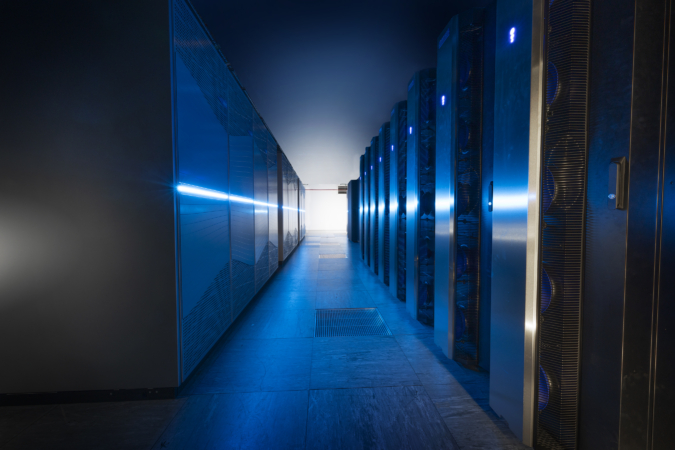
AWE has developed unique, world-leading technology to help validate the UK’s warhead stockpile. Supporting that work requires extremely rigorous testing- and at the heart of it sits Valiant, a new supercomputer that we are proud to say has now entered active service.
This powerful new capability for simulation, testing and discovery significantly boosts our ability to deliver our vital mission: supporting the nation’s nuclear deterrent.
Supercomputers typically have a planned lifecycle of around six years. Our previous system, Vulcan- like all technology- was eventually overtaken by advances in processing power, driving the need for a new generation of computing proficiency.
Just how ‘super’ is Valiant?
Imagine a standard device capable of carrying out a single calculation every second.
You’d need to go back to the late-Jurassic period (163 million years ago) to have enough seconds to match the number of calculations the supercomputer will complete in one second.
That extraordinary ability opens up many new possibilities for scientific insight and research.
Why do we need supercomputers?
As upholders of the Comprehensive Test Ban Treaty (CTBT), the UK does not carry out full testing of nuclear warheads or many of their individual components. Supercomputers therefore play a critical role in modelling and simulation, helping us to assure the safety, reliability and performance of these systems.
The supercomputers also support the physical testing we can safely conduct, such as hydrodynamics experiments and laser-based research. In many cases, tests are first modelled on the supercomputer to validate and refine our plans before work begins.
Speaking about the importance of Valiant, Dr Robert Perridge, Head of Delivery, Scientific Computing at AWE, said:
“Our computing power needs to be able to meet the demands of the business. As our programmes of work progressed at a rapid pace, we knew we needed to upgrade the processing power available.
The new Valiant supercomputer has more processing power in fewer chips and will be able to support our future supercomputing demands.”